

New job postings for full-time experienced tech and professional services positions went up 15% in Q3 2026 compared to the same time last year, but actual hiring fell 8%, according to the High-skilled Job Report for Q3 2026 from professional services firm Toptal.
For experienced professionals, that divergence means a busier job board can coexist with fewer people getting hired. It also raises a question: What is keeping employers from acting on their advertised staffing needs?
“Job postings reflect employers’ intentions, while hiring measures decisions that have already been completed, so some divergence is natural when labor-market conditions are changing,” said Erik Stettler, Toptal’s chief economist and author of the new report. “The size of this gap suggests that companies recognize they need talent but are cautious about committing to additional headcount.”
Stettler also sees a possible mismatch between the capabilities employers want, particularly experience implementing AI, and the experience applicants can demonstrate. This pattern extends beyond the experienced professionals covered by Toptal’s report: The Federal Reserve’s October Beige Book described labor supply as generally adequate but noted persistent shortages of specialized, technical, and skilled trade workers.
There are several overlapping explanations for the gap between job postings and hiring noted in the Toptal report. First, recruitment for a single role can extend beyond one quarter, so a job posted in Q3 may not be filled until the next quarter, or even the next year. Employers may also lack the budget or urgency to fill a posted vacancy, or may post a job and then reconsider the work a position involves or the qualifications it requires.
A listing that remains open for an extended period of time can also reflect a difficult search. In Stettler’s view, employers are more willing to wait for candidates with capabilities they consider essential as AI changes established professional roles.
“Ghost jobs,” or postings for non-existent positions, add another complication. Employers might intentionally post these roles to collect résumés for future openings, gauge the pool of available candidates, or signal growth to employees and potential investors. Some aren’t deliberate: A company’s plans can change after a role is posted, or a job board can copy a listing from another site.
“Ghost jobs certainly contribute to the discrepancy, but we don’t have sufficient evidence to quantify their share, and I would be cautious about attributing the entire gap between postings and actual hires to misleading postings,” Stettler said.
The hiring slowdown varied considerably by occupation, according to the report. Across the nine fields with hiring data, five recorded gaps between stated demand and actual hiring larger than 20 percentage points.
Management consultant roles recorded a particularly sharp divergence. The report’s “stated demand” measure, which combines job postings and the pay offered in those postings, rose 18% year over year, while actual hiring fell 28%. For sales experts, stated demand rose 26% year over year and hiring fell 8%. Marketing expert hiring dipped 2% year over year despite 31% growth in stated demand. Project manager job postings rose 30% year over year, while hiring was essentially flat. Stated demand for finance experts rose 12% year over year while hiring dropped 9%.
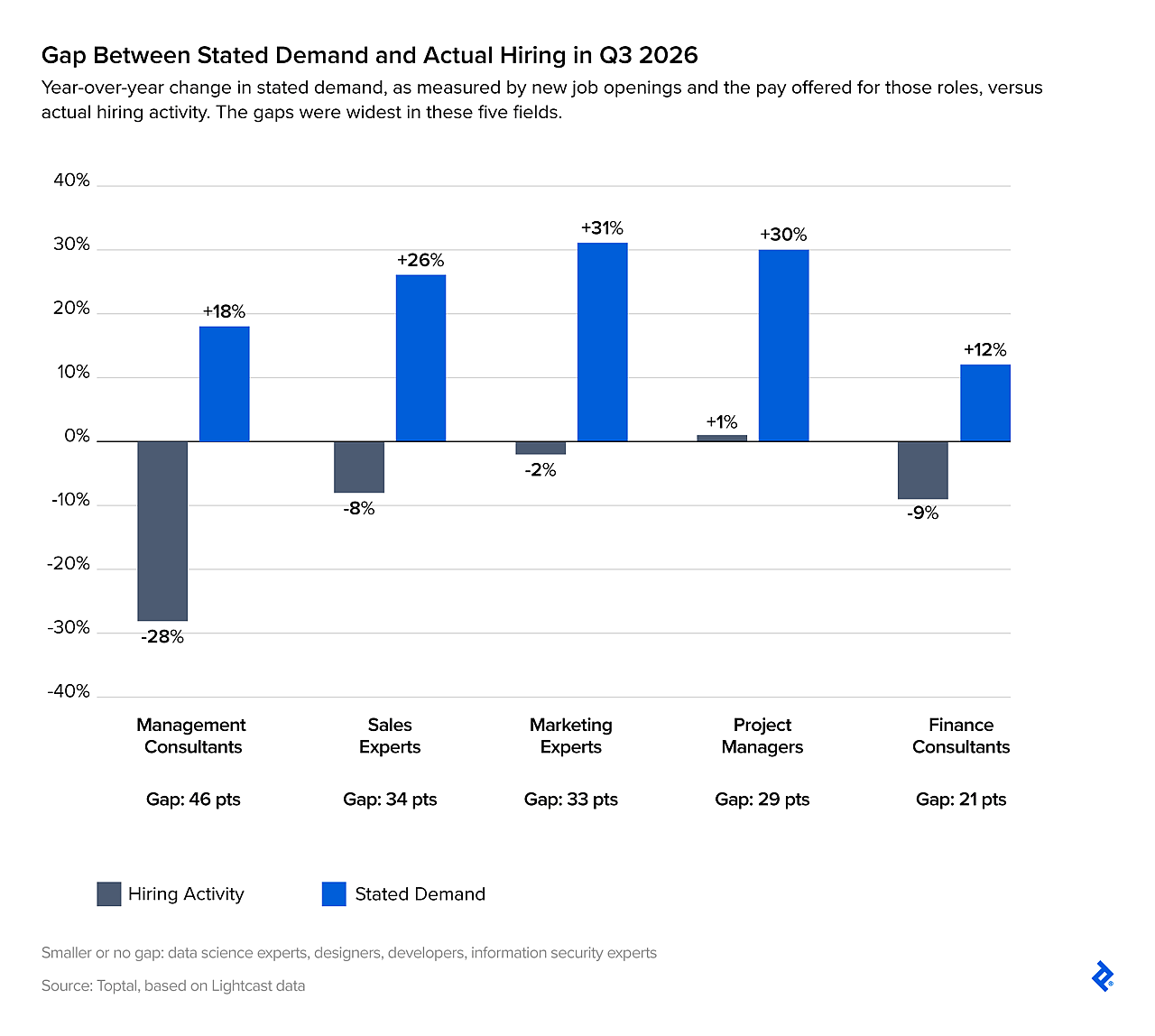
Data for developers and data science experts followed a different course: Hiring rose 3% year over year for each role. Stettler interprets that resilience as a sign that employers are directing resources toward their immediate technology priorities. Development and data science remain central to bringing AI systems into production, while consulting, sales, and marketing are more exposed to discretionary spending decisions and changes in how companies organize work. Stettler cautioned against interpreting the quarter’s results as a permanent shift away from those professions.
The kinds of positions employers advertise are changing, too. The report examines remote and hybrid jobs in more detail because Toptal’s talent network is fully distributed. In seven of the 10 fields tracked, full-time remote and hybrid postings requiring at least 10 years of experience grew more year over year than those requiring five or more.
In development, for example, senior full-time postings rose 23% year over year, compared with 11% for experienced roles overall. In product management, the corresponding increases were 58% and 44%.
Other research points to a broader shift toward senior roles, too. A September Indeed Hiring Lab study found that the senior share of postings in occupations most exposed to AI rose from 22% in 2021 to 47% in 2026. Over the same period, the entry-level share fell from 29% to 10%.
Indeed defines AI exposure by how much of an occupation’s required skills could be performed or substantially reshaped by generative AI.
“Employers appear increasingly willing to pay a premium for professionals who combine deep technical expertise with the judgment and experience to deliver results in complex environments, particularly when implementing AI,” Stettler said.
For applicants, Stettler’s advice is to emphasize the results of their work, rather than focusing on the routine tasks they did. “Professionals should focus on demonstrating specific business outcomes, particularly how they’ve applied AI and other technologies to improve productivity, develop products, or solve complex organizational problems,” Stettler said.
That gives experienced job seekers a concrete way to respond to a selective market: Show what their experience has enabled them to deliver. Employers are more hesitant to commit, but posting trends suggest their need for experienced talent is real. Candidates who can document specific results and demonstrate AI fluency will be in a stronger position when organizations are ready to hire.
This story was produced by Toptal and reviewed and distributed by Stacker.